

Articles — August 25, 2026
Türkiye and Finland: A Growing Tourism Opportunity
Turkey or Türkiye and Finland: A Growing Tourism Opportunity
Turkish travellers are becoming increasingly important for Finland. Strong growth in arrivals and overnight stays, rising outbound travel from Turkey and growing interest in authentic nature-based experiences create a promising outlook for Finnish tourism — particularly beyond Helsinki and Lapland.
A market on the rise
The development of Turkish tourism to Finland has been remarkably positive.
According to Statistics Finland, Turkish visitors generated 37,038 overnight stays and 17,090 arrivals in Finland in 2024. In 2025, the figures increased to 46,930 overnight stays and 22,194 arrivals.
That means overnight stays increased by approximately 27%, while arrivals grew by almost 30% in just one year.
Turkish overnight stays and arrivals in Finland
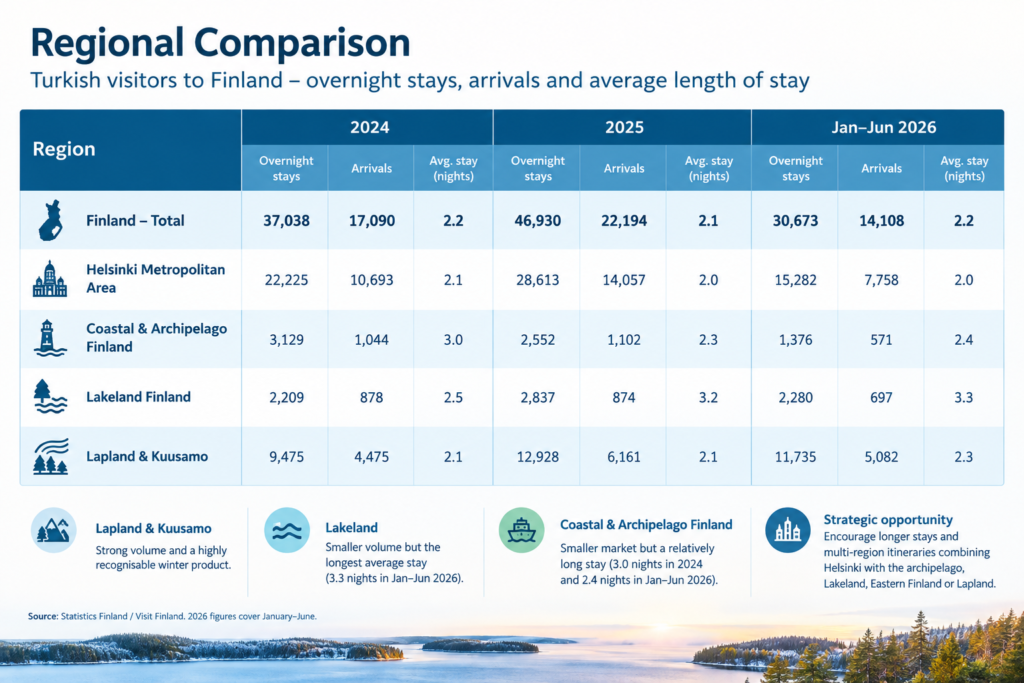
Source: Statistics Finland / Visit Finland. 2026 figures cover January–June.
The figures show two particularly interesting developments.
First, the Turkish market grew strongly in 2025. Second, Lakeland stands out with a considerably longer average stay than the other regions. In the first half of 2026, the average stay of Turkish visitors in Lakeland was 3.3 nights, compared with 2.0 nights in the Helsinki Metropolitan Area and 2.3 nights in Lapland and Kuusamo.
This suggests that Lakeland and Eastern Finland have potential to develop from a secondary destination into a meaningful part of the Turkish traveller’s Finnish itinerary.
Helsinki and Lapland dominate — but there is another opportunity
Turkish visitors currently concentrate strongly on Finland’s two best-known destinations: Helsinki and Lapland.
In 2025, the Helsinki Metropolitan Area accounted for approximately 61% of Turkish overnight stays, while Lapland and Kuusamo accounted for approximately 28%.
Lakeland’s share was smaller, but the longer average stay is particularly interesting from a tourism business perspective.
The opportunity is therefore not necessarily to compete with Helsinki or Lapland, but to add Lakeland and Eastern Finland to the itinerary.
2026: positive momentum continues
During January–June 2026, Turkish visitors generated:
14,108 arrivals
30,673 overnight stays
2.2 nights average stay
Lapland and Kuusamo already accounted for 11,735 overnight stays, while Lakeland recorded 2,280 overnight stays.
Visit Finland’s tourism monitoring has also shown positive development from several international markets during the 2026 winter season. (visitfinland.fi)
Another particularly interesting signal came from Visit Finland’s “Chill Like a Finn” campaign in 2026. The campaign received around 24,000 applications worldwide, with Turkey among the countries generating the highest number of applications. (visitfinland.fi)
This indicates that Turkish interest in Finland extends beyond the traditional winter product. Summer, nature, wellbeing and Eastern Finland also have significant potential.
Why Finland appeals to Turkish travellers
Finland’s tourism proposition matches several broader changes in international travel demand.
Turkish travellers are increasingly looking for experiences that are different from traditional mass tourism. Finland offers a compelling combination of:
Nature – forests, lakes, national parks and untouched landscapes
Winter experiences – snow, Northern Lights, huskies and Arctic experiences
Authenticity – local food, Finnish traditions, cottages and genuine encounters
Wellbeing – sauna, nature, tranquillity and space
Uniqueness – experiences that are difficult or impossible to find in Turkey
Research by Mabrian and Data Appeal highlights growing international interest in emerging European destinations and the importance of authenticity, natural heritage and nature-based experiences in encouraging tourism to less-established destinations. (mabrian.com)
This creates an interesting opportunity for Lakeland, Eastern Finland and North Karelia.
The Turkish outbound market is expanding
The opportunity should not only be viewed from the Finnish side.
The Turkish outbound travel market is also growing. More Turkish residents are travelling abroad, while expenditure on international travel has increased.
According to TurkStat, the number of Turkish citizens travelling abroad increased in 2025, while expenditure on international travel grew significantly. The first half of 2026 has also shown continued growth in outbound travel.
This means that the potential customer base for European destinations is expanding.
For Finland, the timing is therefore favourable: a growing outbound market meets a growing interest in Finland.
Push factors driving Turkish outbound travel
Several factors are encouraging Turkish consumers to travel abroad:
- Growing desire for international experiences
- Search for new and different destinations
- Interest in nature, wellbeing and authentic experiences
- Family and group travel
- Increasing expenditure on international travel
- Interest in European destinations offering something distinctive
These trends create a strong basis for Finland’s tourism proposition.
Pull factors attracting Turkish travellers to Finland
Finland’s strongest competitive advantages include:
Northern Lights
One of the world’s most recognisable bucket-list experiences.
Snow and winter
Finland offers a genuine Arctic winter experience that is fundamentally different from the Turkish climate.
Nature and lakes
Forests, lakes, national parks and the Finnish countryside provide an authentic connection with nature.
Sauna and wellbeing
The Finnish sauna is an internationally recognisable cultural experience and can be combined with nature, food and accommodation.
Silence and space
For visitors from densely populated urban environments, Finnish tranquillity can itself become a tourism product.
Authentic local experiences
Cottages, local food, Finnish traditions and encounters with local people offer experiences that cannot easily be replicated elsewhere.
From Helsinki and Lapland towards Eastern Finland
One of the most promising opportunities is to encourage Turkish visitors to stay longer and explore more of Finland.
What does 2027 look like?
The outlook for 2027 is cautiously optimistic.
Four trends support this view:
1. Turkish outbound travel is growing.
More Turkish consumers are travelling abroad, creating a larger potential customer base.
2. Turkish tourism to Finland is already growing rapidly.
Overnight stays increased by almost 27% between 2024 and 2025.
3. Finland’s strengths match international tourism trends.
Nature, authenticity, wellbeing and less crowded destinations are increasingly attractive to international travellers.
4. Eastern Finland has an opportunity to benefit from tourism dispersion.
The combination of lakes, forests, local culture and authentic experiences makes Eastern Finland highly relevant to this trend.
However, Finland cannot take this growth for granted.
Price, accessibility, air connections, visa procedures and the availability of attractive, bookable tourism products will all influence future demand.
The strategic question for Finnish tourism companies is therefore:
How can we give Turkish travellers a compelling reason to choose Finland — and a reason to stay longer once they arrive?
A market worth developing
The evidence points in one clear direction:
Turkey should be treated as a genuine growth market for Finnish tourism.
The opportunity is particularly interesting for destinations outside the traditional Helsinki–Lapland corridor.
Lakeland, Eastern Finland and North Karelia can offer precisely the type of authentic, nature-based and experience-driven tourism that is gaining international attention.
The next step is not simply to increase awareness of Finland.
It is to create market-ready products for Turkish travellers, build relationships with Turkish tour operators and travel agencies, improve connectivity and give buyers concrete reasons to sell Finland.
The Turkish market is growing. Finland has the product. The opportunity now is to connect the two.
What does this mean for the Turkish market?
The figures suggest that Finnish tourism companies should not look at Turkey only through the traditional Helsinki–Lapland model.
There are at least three interesting regional opportunities:
Lapland & Kuusamo: strong volume and a highly recognisable winter product.
Lakeland: smaller volume but the longest average stay, reaching 3.3 nights in the first half of 2026.
Coastal & Archipelago Finland: smaller market but a relatively long stay, with 3.0 nights in 2024 and 2.4 nights in the first half of 2026.
For the Turkish market, Coastal and Archipelago Finland could be particularly interesting as an extension to a Helsinki stay, offering archipelago scenery, maritime culture, local food, nature and a slower pace of travel.
The strategic opportunity is therefore to encourage Turkish visitors to stay longer and travel beyond the traditional gateways. Rather than selling one destination, Finnish companies could increasingly promote multi-region itineraries combining Helsinki with the archipelago, Lakeland, Eastern Finland or Lapland.
Sources
Statistics Finland – Accommodation Statistics (stat.fi)
Visit Finland – Tourism Statistics and Market Information (visitfinland.fi)
Mabrian / Data Appeal – European Tourism Trends (mabrian.com)
TurkStat – International Travel Statistics (tuik.gov.tr)
