
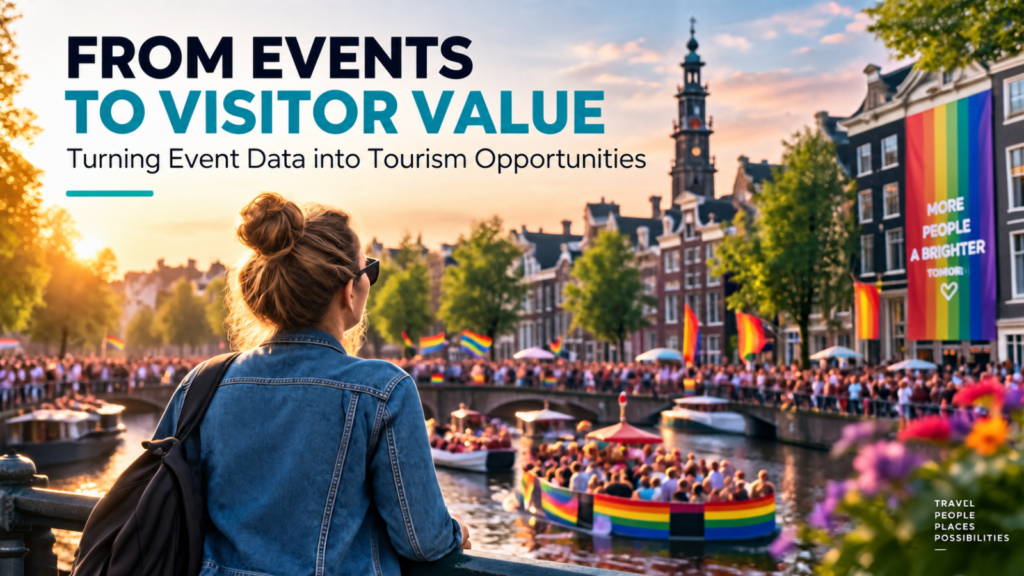
Articles — September 18, 2026
Event Tourism: Turning Data into Revenue
Tourism loves big attendance numbers.
A festival attracted 100,000 people. A major event brought half a million visitors to the city. A record year broke the one-million mark.
Impressive numbers. But commercially, they don’t tell us enough.
I am much more interested in another question:
How much additional tourism spending did the event generate that would not otherwise have happened – and how successfully did local tourism businesses convert that demand into business?
A recent Data Appeal Mabrian analysis of Pride events across Europe provides a fascinating perspective on this.
And although the report focuses on Pride, I believe its most important lesson applies to almost every destination and major event.
7.4 million attendances – but €496 million is the more interesting number
Data Appeal Mabrian analysed 416 Pride-related events across the UK, Spain, France, the Netherlands, Germany and Italy.
Together, they were projected to generate 7.4 million attendances.
But commercially, another number interests me more:
€496 million in incremental event-related tourism spending.
Amsterdam, Madrid, London and Cologne alone accounted for approximately €403 million of that total.
There is an important distinction here.
Rather than simply calculating total spending during an event period, Data Appeal Mabrian aims to isolate incremental tourist economic impact – additional expenditure generated specifically by visitors travelling to the destination to attend an event.
Resident spending, baseline tourism activity and seasonal flows are excluded from this estimate. The modelling uses factors including historical consumption patterns, behavioural data from comparable events and destination- and event-specific characteristics.
That changes the question completely.
Instead of asking:
How many people attended?
We should be asking:
How much valuable tourism demand did the event actually create?
Visitor volume is not visitor value
The differences between the four cities illustrate this clearly.
Madrid was projected to generate more than 2 million Pride-event attendances and approximately €113 million in incremental tourist spending.
Amsterdam: approximately 1.85 million attendances and €131 million.
London: around 1.04 million and €86 million.
Cologne: approximately 1.2 million and €72 million.
The lesson is simple but important.
The largest attendance does not automatically create the highest tourism value.
Nor does the number of events necessarily determine the impact. Cologne had only three Pride-related events recorded in the analysis, yet approximately 1.2 million attendances were projected.
I would therefore encourage destinations to start looking at three dimensions:
VOLUME → VALUE → CONVERSION
How much demand are we creating?
How valuable is that demand?
And how much of that value are local tourism businesses actually converting into revenue?
That final question receives far too little attention.
For a hotel, an event is much more than a room night
I have worked with hotels and international tourism sales for decades. One pattern remains surprisingly common: hotels tend to view major events primarily through occupancy and room rates.
The report shows why we should broaden that perspective.
Across the four highlighted cities, approximately €244 million of incremental Pride-related tourist spending was attributed to food and beverage.
Around six out of every ten euros of incremental on-site tourist spending went to F&B.
That is a powerful commercial signal.
When a major event comes to a destination, a hotel’s question should not simply be:
What rate can we charge for the room?
We should also ask:
What does the guest do before the event?
Where do they eat?
What do they do the following morning?
Could they stay another night?
What additional experiences could we sell?
And perhaps most importantly:
Have we turned any of this into a bookable product before the customer starts planning the trip?
That is when an event calendar starts becoming a commercial tool.
Amsterdam shows what event intelligence can reveal
Amsterdam provides perhaps the most interesting example in the report.
Festivals represented only around 17% of the city’s Pride-related events, yet they accounted for approximately 71% of recorded attendances and 77% of incremental tourist spending.
WorldPride alone was projected to generate approximately one million attendances and €78.5 million in incremental tourist spending.
The report’s geographical analysis also shows that much of the impact is concentrated in Amsterdam’s city centre.
That raises a question I would ask any destination:
Do you know where your events take place – or do you also know where the money generated by those events flows?
Those are two different things.
Once we understand the latter, we can start making much better decisions about accommodation, restaurants, transport, experiences, retail and product development.
Turn the event calendar into a demand calendar
Most destinations already have an event calendar.
But an event calendar mainly tells us what is happening.
A commercially driven destination also needs a demand calendar.
For every strategically important event, I would want to understand potential attendance, source markets, expected length of stay, accommodation demand, pricing signals, spending potential and the most relevant customer segments.
Then comes the part where tourism becomes business:
SIGNAL → DEMAND → PRODUCT → PRICE → DISTRIBUTION → BOOKING → REVENUE
Data identifies the signal.
But data does not build the hotel package.
It does not negotiate with the tour operator.
It does not open the distribution channel.
And it does not ensure that an international traveller can actually discover and book the product.
That still requires commercial tourism expertise.
The next shift will come from AI
There is another layer that I believe will significantly change event tourism over the coming years.
Travellers will not necessarily start their search with:
“Hotels Amsterdam WorldPride”
They may instead ask an AI assistant:
“Where should we stay in Amsterdam during WorldPride if we want a boutique hotel close to the events but in a quieter neighbourhood?”
Or simply:
“Build me a four-day trip around this event.”
At that point, competition is no longer only about your Google ranking or your position on Booking.com.
It is also about what AI knows about your product and whether it can recommend it in the right context.
This is why I increasingly see three capabilities coming together in commercial destination management:
Demand Intelligence → Commercial Readiness → AI Visibility
First, understand where demand is emerging.
Second, make sure there is something genuinely bookable.
Third, make sure it can be discovered in the environments where customers increasingly make their decisions.
What years of international sales have taught me
Over my career, I have met more than a thousand international tour operators and participated in hundreds of trade fairs and workshops.
Buyers rarely need more generic inspiration.
They need something they can sell.
A clear product.
A price.
Availability.
Accessibility.
Commercial terms.
And a compelling reason to include the product in their programme.
The same applies to events.
A world-class event can create an enormous demand spike. But if there is no bookable tourism product around it, part of that commercial opportunity simply passes by.
That is why I would not start event tourism development with a marketing campaign.
I would start with commercial product development.
In five years, the event calendar will look very different
Over the next year, I expect destinations to increasingly combine event, aviation, accommodation and demand data.
Over the next three years, AI is likely to change substantially how event-related trips are discovered, planned and compared.
And within five years, I believe the most commercially advanced destinations will no longer treat events primarily as individual marketing opportunities.
They will use them as predictable demand signals.
If a destination knows months in advance that exceptional demand is likely to emerge at a particular time, it can productise, price, distribute and start international sales before competitors react.
That is a significant competitive advantage.
An event itself is not a tourism product.
A tourism product only emerges when we build around that event a reason to travel, an easy way to buy and enough value to stay.
Key takeaways
- Attendance alone does not reveal the true tourism value of an event.
- Event intelligence should be connected with spending, length of stay, accommodation demand and visitor behaviour.
- F&B, mobility and additional services can represent a substantial part of the commercial opportunity.
- Destinations should turn their event calendars into commercial demand calendars.
- AI visibility is becoming another layer of tourism discovery and distribution.
What should destinations and tourism businesses do next?
Select the five events with the strongest international potential in your destination over the next 12 months. Assess their likely tourism demand and key source markets. Build bookable accommodation, dining and experience products around them. Review pricing, availability and distribution well before demand peaks. Finally, test whether those products can actually be found through Google, OTAs and generative AI services when an international traveller begins planning the trip.
The question is no longer simply how large an event your destination can attract.
The real question is how much of the tourism demand generated by that event you can convert into business.
How closely is your destination’s event calendar currently connected to product development, international sales and distribution?
Source: The Data Appeal Company / Data Appeal Mabrian & Queer Destinations, The Pride Effect: Measuring Tourism and Economic Impact Across Europe, 2026. Figures referenced above are forecasts/modelled estimates according to the methodology described in the report, rather than final observed expenditure figures.
